
Optical coatings are used in industrial laser processing, machine vision, optical measurement, medical and life science instruments, and automotive optical sensing. Their functions include reducing unwanted reflections, controlling transmission, reflecting selected wavelengths, and filtering or separating spectral bands. The same clear-looking window can therefore serve very different purposes: transmitting a processing laser beam, protecting a camera, or selecting the light reaching a detector.
Optical Coatings in Industrial Laser Systems
Laser cutting, welding and marking systems use coated optics at different points in the beam path. Anti-reflection (AR) coatings on protective windows and transmission optics reduce surface reflections at the working wavelength. Reflective coatings on mirrors direct the beam where the optical design requires reflection. These functions need to be specified separately; a transmitting window and a steering mirror have different optical targets.
Working wavelength is only part of the decision. The coating also encounters the actual beam intensity, angle and polarization. Continuous-wave and pulsed operation impose different demands, so a laser damage threshold is meaningful only with its test conditions. Absorption within a coating or at an interface can produce local heating and damage, as explained in Edmund Optics’ technical note on high-power coatings. A high transmission figure alone does not establish suitability for a processing laser.
Optical Coatings for Machine Vision and Industrial Imaging
Industrial cameras, machine vision lenses and automated optical inspection systems need usable image contrast. AR coatings help reduce unwanted surface reflections through the imaging path. Spectral coatings serve a different purpose: a bandpass filter can select the illumination band used to inspect a part while rejecting light outside that band. SCHOTT identifies machine vision bandpass filters and coated image-sensor glass among established coating applications.
Filter selection needs to match the light source, the feature being inspected and the sensor response. A narrow band that helps a monochrome inspection may discard information needed by a color camera. Coatings can support an imaging design, but they do not compensate for unsuitable illumination or guarantee better images in every system.
Applications in Optical Instruments and Measurement
Spectrometers and laboratory instruments often need to distinguish one part of a spectrum from another. Coated filters select a measurement band or suppress unwanted wavelengths before light reaches the detector. Dichroic optics separate bands by transmitting one and reflecting another. Beam splitters divide light between paths, for example where an instrument uses a measurement path and a reference path.
In a precision optical system, the required balance of transmission and reflection follows the measurement design. An optic that passes enough total light can still be unsuitable if it transmits unwanted wavelengths into the detection channel. Spectral curves over the relevant bands are therefore more informative than a broad description such as “high transmission.”
Optical Coatings in Medical and Life Science Equipment
Microscopy, diagnostic optical imaging and fluorescence detection use coatings to manage illumination and detected signals. A fluorescence optical train commonly combines an excitation filter, a dichroic element and an emission filter. Each has a distinct job: selecting excitation light, separating the illumination and detection paths, or passing fluorescence while suppressing residual excitation. Edmund Optics’ fluorescence filter overview explains how these elements work together.
The filter set must match the excitation and emission characteristics of the fluorophore and the instrument geometry. These are industry application examples; they do not establish a supplier’s medical certification or qualification for a particular diagnostic device.
Automotive Optical Sensors and Imaging Systems
Vehicle cameras and optical sensors rely on transmission through windows and lenses, with reflection control helping limit unwanted light within the optical path. LiDAR systems also use coated transmitting and receiving optics; wavelength-selective filtering can help separate the intended signal from out-of-band light.
The installation environment adds another layer of requirements. Temperature changes and condensation can affect an optical surface, while the handling demands of an exposed window differ from those of an internal optic. Fraunhofer IOF’s work on reflection and fogging in LiDAR optics illustrates why optical and environmental functions must be considered together. Such specialized functionality requires its own evaluation; an AR coating alone is not evidence of automotive qualification.
Why Coating Requirements Differ Between Applications
An industry name is a starting point, not a coating specification. Two windows of similar shape may need different coatings because one transmits a narrow laser line and the other works across an imaging band. The intended function sets the transmission or reflection targets. The substrate also affects the coating decision; our article on optical coating for glass, plastic and metal substrates discusses that subject separately.
Installed geometry matters as well. An interference filter’s spectral response can shift when the angle of incidence changes, and polarization may affect transmission or reflection. The filter data should be evaluated at the relevant angle and beam geometry, rather than assumed to apply unchanged after installation.
Acceptance criteria should follow the application. For a filter, that may mean agreed transmission and blocking across defined bands; for a laser optic, it also requires attention to operating and test conditions. Environmental requirements and the inspection method should be agreed alongside the optical targets. A component’s appearance cannot verify its spectral performance.
Optical Coating Production at Likai Laser
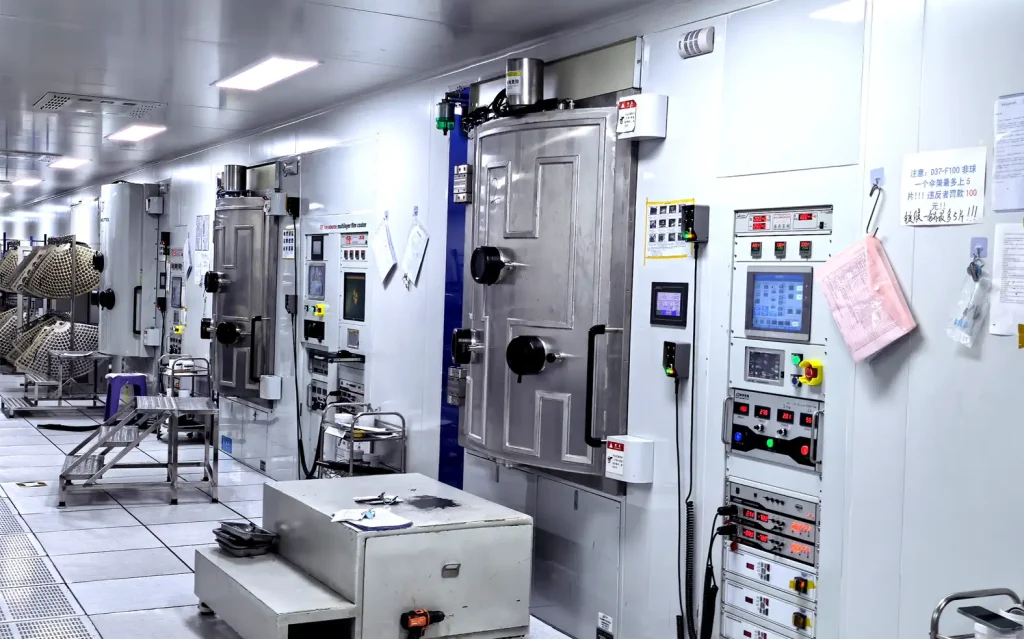
Likai Laser’s optical coating production takes place in a filtered cleanroom environment. Personnel wear cleanroom garments and pass through an air shower before entering the controlled production area. Optical components are handled and inspected under clean conditions during relevant manufacturing stages.
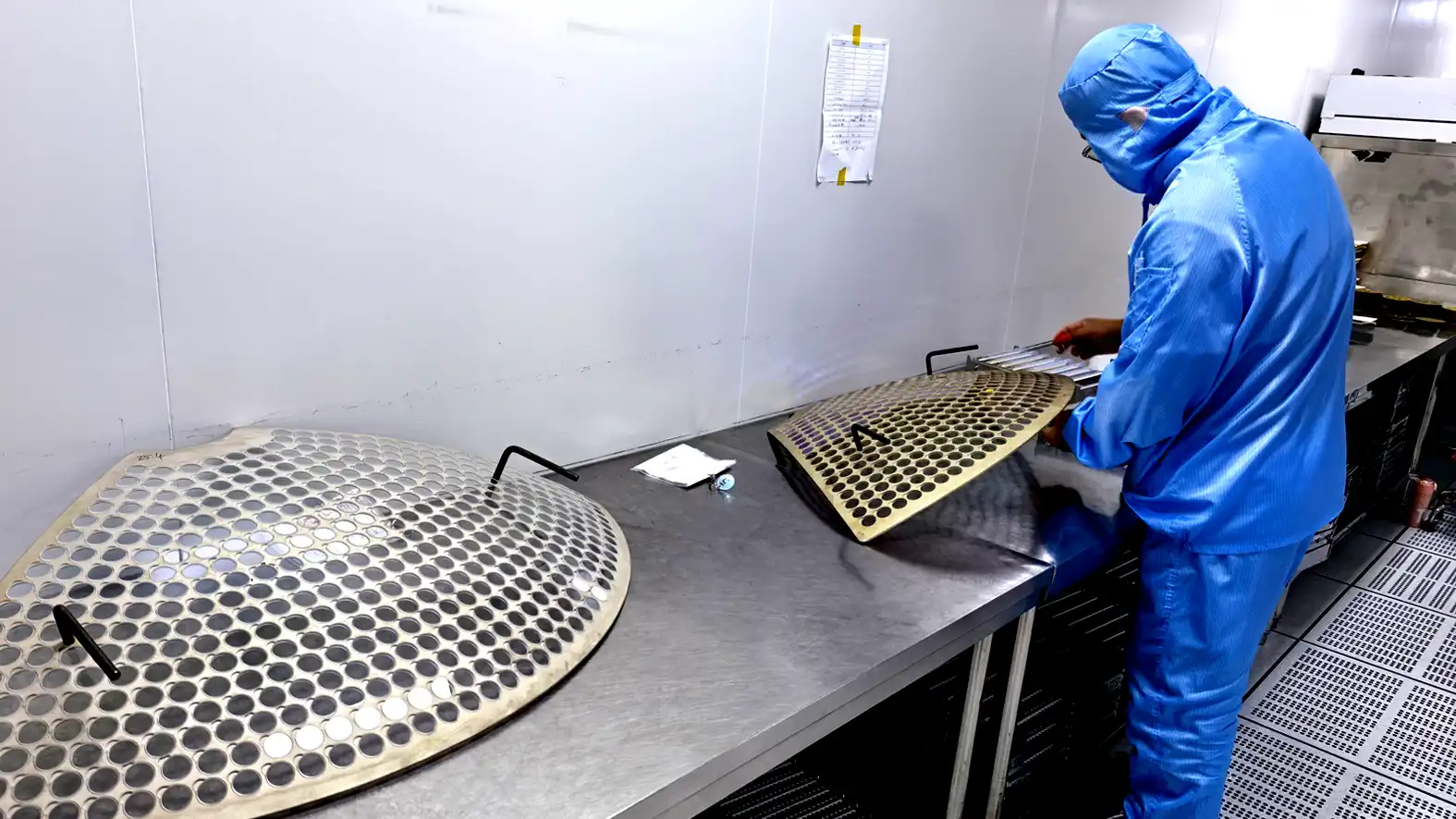
The photograph shows post-coating unloading and handling: components are being removed from coating fixtures after coating is complete. Controlling contamination remains relevant at this stage because deposited particles or residue can affect optical surfaces. The image documents handling, rather than a performance test or inspection result. For the wider production sequence, see our optical lens manufacturing process.
For a coating enquiry, describe what the optic must do in its actual equipment. That gives a more useful basis for technical evaluation than the industry label alone. Contact Likai Laser to discuss the application and the coating requirements that need to be evaluated.