
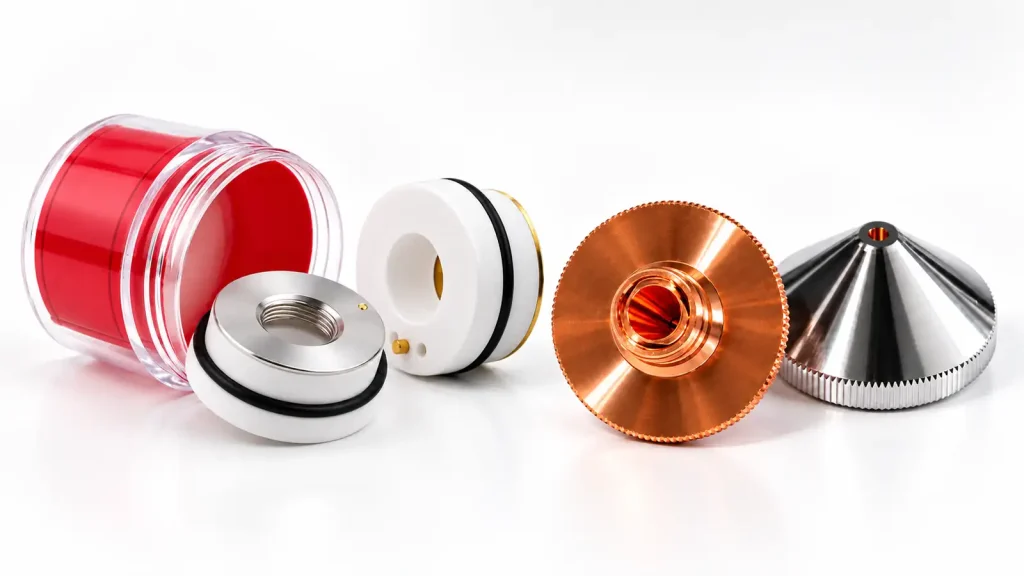
Fiber laser cutting systems rely on replaceable consumables and internal components for daily operation, maintenance and consistent cutting performance. Purchasing teams may need cutting nozzles, ceramic rings, protective optics, internal lens assemblies and cleaning tools, each with a different specification. Knowing which component is required helps avoid ordering a part that looks familiar but does not match the equipment.
Likai Laser supplies standard laser cutting consumables and can evaluate custom production based on drawings, samples or specifications. The products shown on the website represent only part of the range. Buyers can contact the team for additional product information and discuss requirements that are not illustrated online.
Common Fiber Laser Cutting Consumables
A replacement-parts list extends beyond nozzles. Depending on the cutting-head configuration and maintenance requirements, common purchasing categories include:
- Nozzles used near the cutting area
- Ceramic rings associated with the nozzle mounting arrangement
- Protective optics, including protective lenses or windows
- Internal lens assemblies and related holders or modules
- Cleaning swabs, tools and other maintenance consumables
These items do not all follow the same replacement schedule or identification method. Different cutting heads can use different dimensions, structures and interfaces, so a general product name is only a starting point. For a mixed order, list each component separately and connect it to the equipment or existing part it is intended to replace.
Fiber Laser Cutting Nozzles
The nozzle sits close to the cutting area and helps deliver cutting gas toward the workpiece. It is a replaceable component whose geometry and interface must suit the intended setup. Selecting a replacement involves more than matching its color or overall appearance.
Likai Laser offers standard nozzles in multiple sizes and specifications. Website photographs show selected products rather than a complete model list; if the required nozzle is not shown, request further product information. Include the existing part reference and any available dimensions so the inquiry can be narrowed down.
For an unusual size or structure, a drawing or sample can support a custom-production review. Identify which dimensions are confirmed and which still need checking. A worn or damaged nozzle should be described as such, because it may no longer represent the intended original geometry.
Ceramic Rings
Ceramic rings are common replacement components in cutting-head nozzle mounting arrangements. Their fit depends on the corresponding assembly, so they should be identified separately from the nozzle itself. A similar-looking ring is not sufficient evidence of compatibility.
When sourcing a replacement, confirm the dimensions, interface and structure against the cutting-head specification. Provide photographs from more than one angle to show the mating surfaces and other identifying features. If the available information is incomplete, a drawing or existing sample can help establish what needs to be confirmed before an order is placed.
Protective Optics and Internal Lens Assemblies
Protective optics help shield internal optical components from contamination associated with the cutting process. A cutting head may also contain lens assemblies and related holders or modules. These are distinct purchasing items: a protective window, an individual lens and a complete assembly should not be treated as equivalent replacements.
An inquiry should identify the component’s position and function, dimensions, structure and optical requirements. For an assembly, clarify whether the request covers the optical element alone or the holder and assembled module as well. The cutting-head configuration provides essential context for reviewing the requirement.
If an established standard product does not match, share a drawing, sample or existing specification for assessment. Physical dimensions alone do not establish optical suitability. Any missing requirements should be resolved before a replacement is selected, rather than inferred from a photograph.
Cleaning Tools and Maintenance Consumables
Cleaning tools support the handling and care of optical surfaces and internal cutting-head components. Purchasing requirements may include cleanroom swabs, wiping materials and other maintenance supplies. The tool needs to suit the surface and the maintenance procedure, not simply fit into the available space.
Clean handling matters when inspecting, storing or replacing optics. Specify the intended use and follow the equipment or component manufacturer’s maintenance instructions when selecting tools and methods. An inquiry for cleaning supplies should distinguish between tools for optical surfaces and items used elsewhere on the equipment; this article does not prescribe a cleaning chemical or procedure.
Standard Products vs. Custom Production
Likai Laser has a range of mature standard products for commonly used laser cutting consumables. Established specifications make repeat purchasing easier by giving both buyer and supplier a defined reference. Once a product has been confirmed for the application, subsequent orders can refer to the same specification instead of restarting identification from photographs.
For maintenance teams and distributors, keeping that reference alongside the purchasing record supports consistent sourcing. Record any agreed variation clearly, particularly when similar parts are used across several machines. A standard product remains subject to compatibility confirmation; being commonly used does not make it universal.
Custom production starts with a review of drawings, samples, dimensions, structure, specifications and estimated quantity. Discussion of the manufacturing process can help establish what work the part requires and what information is missing. Assessment is necessary before feasibility is confirmed; submitting a custom inquiry is not a guarantee that every requested design can be produced.
Why Order Quantity Matters
Laser cutting consumables are generally well suited to repeat or volume purchasing, especially when custom manufacturing involves setup, tooling or several production steps. Very small custom orders may carry disproportionately high unit costs because preparation work is spread across fewer parts. This does not mean that every small order is unsuitable.
For custom requirements, provide the expected quantity so manufacturing feasibility and cost can be evaluated together. If the first requirement is a trial quantity and later purchases are anticipated, explain both stages without presenting a forecast as a committed order. Separating the immediate requirement from possible ongoing demand gives the supplier a more useful basis for review.
What Information Should You Provide When Requesting a Quote?
A clear inquiry connects the requested item to its specification and intended use. Provide the information available, and mark anything that remains uncertain:
- Product type
- Existing product or reference number, if available
- Clear photographs
- Drawings, if available
- Dimensions
- Thread or interface information, if applicable
- An existing sample, if available
- Required quantity and any expected repeat purchasing requirement
- Whether the requirement is standard or custom
- Machine and cutting-head information, or the intended application, if known
Customers without complete drawings can begin with clear photographs and key dimensions, then discuss whether a physical sample would help. Label each photo or drawing to match the relevant item in a multi-product inquiry. Detailed documents and sample arrangements can be discussed by email after the initial contact.
How to Source the Right Replacement Consumables
Start with the existing product information and compare dimensions, geometry, interface, specification and application. Appearance can help identify a candidate, but it cannot confirm that a part is suitable. Do not assume that parts for different equipment are interchangeable.
Where the model is uncertain, supply photographs, measurements, an original sample or existing product documentation. Ask for unresolved features to be identified before ordering. For repeat purchases, retain the confirmed specification and record changes to the equipment or requirement so that an earlier order is not reused after the application has changed.
Discuss Your Laser Cutting Consumable Requirements
Likai Laser supplies standard laser cutting consumables for repeat and volume purchasing and can evaluate custom requirements based on drawings, samples and specifications. If you are looking for nozzles, ceramic rings, protective optics, lens assemblies or maintenance consumables, contact our team with your product details and estimated quantity.